Editorial Process &
AI Transparency
TheNewsPublisher (TNP) is a result of a year-long deep collaborative partnership between human vision and modern artificial intelligence technologies. TNP uses a Human-in-the-Loop workflow to curate, summarize, and publish news responsibly.
Overview
We believe in transparency: here is exactly how our system works.
Sources
Curated from thousands of reputable publishers, official feeds, and domain-specific sources.
Methods
Structured via aiContext rules — using publication-specific context
engineering; not generic prompts.
Oversight
Human experts define policy, tone, and exclusions. AI executes the guardrails.
Attribution
We credit original publishers and link back. We do not replace reporting.
How TNP Publishing Works
We turn high-volume, noisy information into a reliable, structured reading experience—without hiding how it’s produced.
Acquire
We ingest content from diverse sources—News APIs, RSS feeds, newspapers, and apps—bringing raw information into the Forge.
Orchestrate
"Don't code; configure." We route content through strict filters, logic flows, and integrity checks before it ever reaches the AI.
Curate
The aiContext engine and human editors work as "dance partners"—transforming
raw data into intelligent, values-driven narratives.
Publish
We deliver the finished product via Publisher Kits to Ghost, WordPress, or APIs, building a media empire endpoint by endpoint.
What makes TheNewsPublisher different?
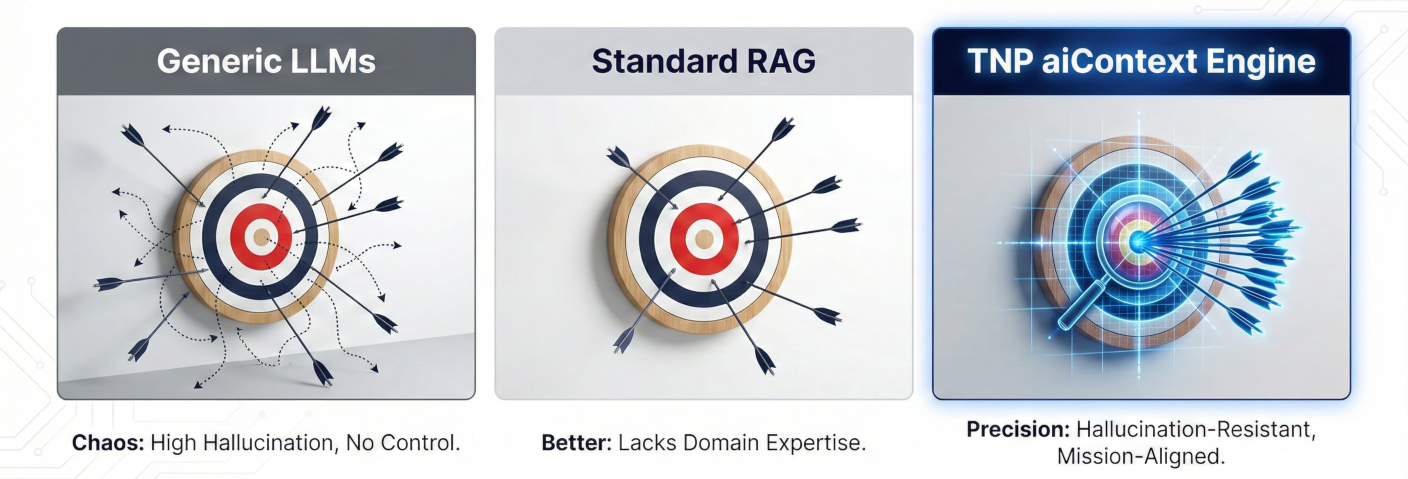
TNP is not “generic AI summarization.” Each publication has a dedicated
aiContext—a structured editorial spec that teaches the underlying
foundational AI engine what matters, what to ignore, and how to frame content responsibly
for that specific audience.
Augmented Intelligence
“Built by humans, scaled by machines.
”
1. Data Ingestion
We source raw content from multiple channels depending on the publication’s mission. The goal is breadth with control—high coverage without letting noise through.
Typical Sources
- Global news APIs and syndication feeds
- RSS feeds from reputable publishers
- Official government or institutional releases
- Industry-specific regulatory updates
Publication-Specific Tuning
Each TNP publication is configured with a curated set of source patterns:
- Immigration: Policy updates, court actions, credible reporting.
- Cybersecurity: Vulnerability disclosures, advisories.
Note: We don’t claim ownership of original reporting. We credit sources and link readers back to the original publisher whenever possible.
2. The Contextual Engine
Our AI layer is designed to be context-driven and constrained—not random text generation. It transforms raw articles into structured, publication-ready output.
Relevance Filtering
Evaluates mission fit. Sensational or off-topic content is rejected.
Structured Summaries
Generates consistent headlines, takeaways, and tags for a predictable reading experience.
Taxonomy & Metadata
Classifies content into defined sections to build topic authority.
What is aiContext?
aiContext is a publication-specific editorial blueprint: mission, target
audience, topic scope,
tone requirements, exclusions, and analytical directives. It acts as “editorial policy
as
code,” guiding the AI
to deliver consistent, accountable outputs for each publication.
3. Human Oversight
Humans set the guardrails. AI executes them at scale. This is how we stay consistent and responsible.
Humans set the rules
We define mission, tone, topic scope, and content restrictions before the AI writes a single word.
Humans review and iterate
We perform periodic reviews for drift, update policies as topics evolve, and correct errors when found.
This approach is designed to support transparency and long-term trust: readers should understand how the system works, not guess.
Fact Checking & Attribution
TNP’s outputs are summaries and structured interpretations of source material—not replacements for original reporting. We prioritize attribution and traceability.
Source Attribution
Every curated story includes attribution to the original publisher when available, and typically links back to the source for full context.
AI Disclosure
When AI is used to generate summaries or insights, we disclose that AI assisted in producing the content. Our goal is clarity, not ambiguity.
Corrections Mindset
If an issue is discovered (misclassification, broken link, inaccurate interpretation), we update the post and refine the policy to reduce repeat errors.
Important Note
No AI system is perfect. That’s why we treat transparency and continuous improvement as a core product requirement—not an afterthought.
Common Questions
Is this fully automated publishing? ▼
The pipeline is automated, but not “uncontrolled.” Humans define publication policy, scope, and guardrails, and we review outputs over time to prevent drift.
Does TNP replace journalism? ▼
No. We rely on original reporting. Our role is curation and synthesis—helping readers discover and understand important stories faster while crediting sources.
How is this different from generic AI summaries? ▼
Generic summaries optimize for “one prompt, one answer.” TNP optimizes for ongoing publishing: consistent taxonomy, mission-aligned filtering, repeatable outputs, attribution conventions, and auditability.
Want a publication powered by this process?
If you’re exploring a niche publication, an industry intelligence briefing, or a brand newsroom, we can show you how TNP operationalizes trust at scale.